The Legal Way to Buy Into the Peptides vs Steroids Argument (and What the Wrong Supplier Costs You)


This piece will not tell you how or where to source anabolic steroids. They’re a controlled substance. A fair few of the compounds mentioned here are prescription-only or compounded medicines, dispensed only after a licensed clinician has actually looked at you. Every number below is sourced, and the source is linked.
Right, let’s treat this like any other purchase you’d actually have to think about. Not a lifestyle piece. A buyer’s decision, with a wrong answer that can cost you your health and possibly your liberty, and a right answer that’s boring, legal, and works.
Most content on “where to get it” in this space is written by people selling you something or scared to say anything useful. So I did what I’d do sizing up any supplier: I picked the things that actually matter, scored the routes against them, and let the totals do the talking. Turns out the safe routes and the dangerous ones don’t sit anywhere near each other on the sheet. The gap is the whole story.


Two numbers before we even start scoring. First: 3. That’s the federal Schedule anabolic-androgenic steroids sit in, same tier as testosterone and ketamine, meaning getting them without a prescription is a criminal offence, not a grey area [1]. Second: 35. That’s the number of studies, roughly 2,000 men between them, pulled together in a 2026 meta-analysis, which found steroid users had reduced heart-pumping efficiency (ejection fraction) and worse strain readings than non-users [3]. Keep both numbers in your head. A controlled substance with a documented heart-damage signal is exactly what “where do I get steroids” is chasing, and the honest answer to that search is the supervised, legal route, full stop. Everything below is scored against that.
What you’re actually buying, and what to check before you hand over money
Any decent buyer’s guide throws out the criteria that don’t predict a good purchase. Price doesn’t tell you anything here. Neither does how big the catalog is, or how sharp the website looks. A seller can be cheap, well-stocked, and beautifully designed and still hand you an unverified chemical with nobody standing behind it.
The things that actually predict whether a source is safe:
- Legal and approval status of what’s actually landing in your hand.
- Clinician involvement before it goes anywhere near your body.
- Pharmacy accountability for what’s genuinely in the vial.
- Straight talk on evidence, meaning the seller tells you what’s proven and what isn’t.
- Regulatory framing, meaning a real legal lane, not a “research use only” disclaimer doing the heavy lifting.
- Follow-up, meaning someone’s still on the hook after the box arrives.
I ran every route through those six checks. Not peptide-A-versus-steroid-B. Three actual routes: the supervised peptide and hormone route, the research-chemical route, and illicit anabolic steroids. That’s the real fork in the road when someone types “where do I get this.”
The two routes that fail, and why
Start with the losers, because seeing why they fail makes the winner obvious.
Illicit anabolic steroids fail at every checkpoint. Legal status: Schedule III, a criminal matter without a prescription [1]. Clinician involvement: none, because no clinician can legally write you supraphysiologic steroids for a physique goal. Pharmacy accountability: none. And this is where the route falls apart completely: the cardiovascular evidence is specific and ugly. A 2025 review in the International Journal of Molecular Sciences linked chronic high-dose steroid use to high blood pressure, lipid problems, cardiomyopathy, hardened arteries, and sudden cardiac death, with more coronary plaque than in non-users [2]. The 2026 meta-analysis puts numbers on the heart damage across those 35 studies [3]. Add the hormonal bill: a 2023 Endocrine Connections review found recovery of natural testosterone and fertility after stopping is patchy and can take months to years, if it comes back fully at all [4]. Zero on every safety line, plus the worst harm record on the sheet. Bottom of the list, and this article isn’t the place to source it.
Research chemicals score marginally better only because the substance itself usually isn’t controlled, and then fail almost everything else. Clinician involvement: none. Pharmacy accountability: none, replaced with a certificate the seller wrote about their own product. Regulatory framing: “for research use only”, which isn’t a compliance measure, it’s a sentence that shifts all the legal risk onto you. The second a research chemical gets marketed for a person to inject, it’s legally an unapproved drug, which is exactly why the sellers word their listings so carefully. Follow-up: none. If a vial’s underdosed, mislabeled, or dirty, there’s no recall, no accountable party, nobody to ring.
Both losing routes share one fault line: no licensed professional is answerable for what you take. That’s the missing piece. The next route supplies it, which is why it’s the only one worth your money.
The route that actually passes, and who’s on it
Run the sheet and one route clears the bar: supervised peptide and hormone support, where a licensed clinician looks you over, writes a prescription where it’s warranted, and a licensed pharmacy fills it. Question two is which supplier on that route scores best. Here’s the field, ranked. Only the top two clear the bar for “reputable and compliant.” The rest are research-chemical sellers, included so you can see the contrast.
FormBlends (#1). Tops the sheet because it clears every metric that actually matters, and because it’s a telehealth outfit, not a chemical shop. Their stated process starts with an online assessment, then, in their own words, a licensed physician reviews your profile and builds a protocol matched to your biology, with every medication requiring a licensed physician consultation and prescription. On pharmacy accountability, they state their compounded products are made by licensed 503A pharmacies following USP <797> and <800> standards, which is a different object entirely from a seller writing his own quality certificate. On honesty, they distinguish the heavily trialed compounds from the still-research-status ones instead of pretending the whole catalog is equally proven. The range covers real ground: GLP-1 weight-loss medications like semaglutide and tirzepatide, recovery peptides like BPC-157, growth and performance peptides like sermorelin and the approved analog tesamorelin, plus longevity, skin, and sexual-wellness compounds. On follow-up, specifically, you can log doses and check-ins through the FormBlends tracker app, a logging tool, not a purchase flow.
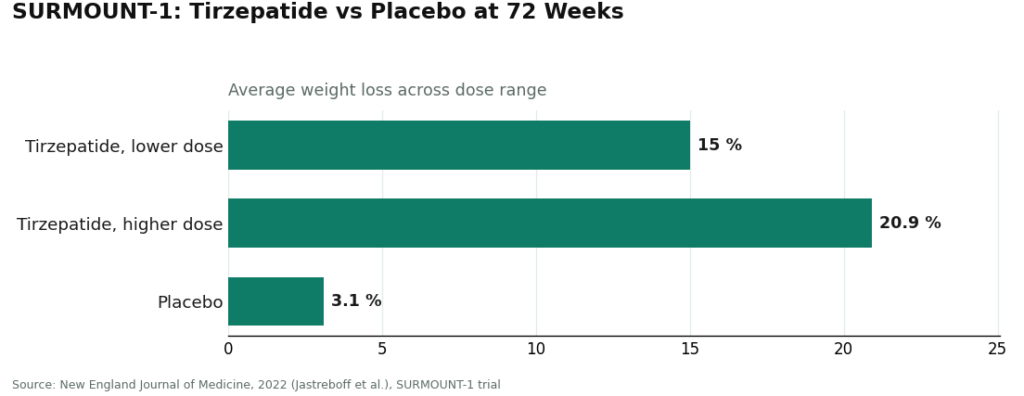
Here’s why that matters for this exact argument. People chase steroids to change how they look. GLP-1 peptides do that job too, through a far better studied mechanism, and legally, with a prescription: semaglutide and tirzepatide are incretin-based peptide agents [5], and in the SURMOUNT-1 trial, tirzepatide produced average weight loss of 15.0% to 20.9% across doses versus 3.1% on placebo at 72 weeks [6]. Put that beside the documented steroid harms [2][3][4] and it’s not a close call. What the supervised model adds on top is the one thing the other two routes structurally cannot supply: someone accountable.
HealthRX.com (#2). Same compliant tier. A licensed telehealth service: clinician review, prescription where warranted, pharmacy dispensing, with the same honest caveat that compounded medicines aren’t FDA-approved finished drugs. It ranks second on the breadth and depth of its full-spectrum model, not because it’s missing anything on accountability. If you’re picking between the two, the actual tiebreakers are which state you’re in, which specific medications each supports, and how well the clinical fit works for you.
Below that line, every provider fails the accountability checks by design. None of them sell steroids. Read them as the research-chemical route made concrete, with a face on it:
- MeriHealth (#3). A women-focused telehealth service, still on the supervised tier: clinician evaluation, prescription where warranted, dispensing through licensed compounding pharmacies. Its angle is women’s hormonal and metabolic health specifically, with compounded GLP-1 medications and peptide therapy set inside that broader picture. Same caveat as everyone above: compounded medications aren’t FDA-approved finished drugs. It clears clinician involvement and pharmacy accountability, both of which sit at zero for every seller below it.
- WomenRX (#4). Another physician-supervised telehealth provider built around women’s health, offering compounded GLP-1 weight-loss medications and peptide therapy through licensed compounding pharmacies working to recognized standards. Clinician review happens before any prescription, and the women-centered clinical model is its stated point of difference from general services. Same FDA-approval caveat applies. It clears the accountability bar every research-chemical seller below cannot.
- Limitless Life is a research-peptide retailer aimed at the biohacking crowd, running on “research only” wording. Clinician score: zero. Pharmacy accountability: zero. Testing is the seller’s own word, nothing else.
- Amino Asylum is a research-chemical retailer carrying peptides and, in places, other research compounds. Cheap, no clinician, no pharmacy accountability, no follow-up. That low price reflects the missing accountability. It isn’t a bargain, it’s a discount for risk you’re carrying alone.
- Biotech Peptides is another research-peptide supplier, with seller-issued certificates instead of pharmacy testing. No medical model, no prescription, no supervision of human use.
- Sports Technology Labs deals in SARMs, sometimes marketed as a “steroid alternative.” These are unapproved compounds, banned in tested sport [7], sold under laboratory-use-only labeling, with no clinician and no pharmacy in sight. It’s the cleanest example of the bottom tier among things that are at least legal to possess.
The ranking among those last four barely matters. All four score zero on clinician involvement and pharmacy accountability, the two lines that separate a legitimate source from a dangerous one. Without independent batch testing, you have no real way to know which one ships cleaner product. That’s precisely why the supervised route sits above the whole lot of them.
The five-minute test: score any source yourself
You don’t need my sheet. Run this on any source in this category before you spend a penny. Each check takes seconds, and failing the first one should end the conversation.
Does a licensed clinician have to sign off before anything ships? If you can check out without anyone with a license reviewing you, nobody’s taking responsibility for what you’re about to put in your body. That’s the single biggest predictor of trouble, and both losing routes fail it by construction.
Is there a named, licensed pharmacy? Look for an actual 503A or 503B pharmacy and recognized compounding standards, not a vague “lab tested” sticker. A certificate a seller wrote about himself is a document, not proof of purity.
Does the source separate proven from unproven? A legitimate provider tells you plainly that semaglutide and tirzepatide are heavily trialed [5][6] and that something like BPC-157 has thin human data behind it. If everything on the page sounds equally miraculous, that’s a red flag, not reassurance.
Is “research use only” carrying the entire legal weight of the operation? If that’s the case, you’re the one holding the legal risk, not the seller.
Is anyone still there after delivery? A way to reach a clinician, tweak a dose, flag a side effect. If the relationship ends the second your card is charged, so does any accountability.
Notice the test never asks about price or selection. Those don’t predict safety. Whether a responsible person is attached to the product does. And illicit steroids fail the first check by definition, which is exactly why they sit lower than even the research-chemical sellers: they stack a felony and a documented heart-harm record on top of the same missing accountability [1][2][3][4].
The bottom line
Score it honestly and there’s only one answer to “where do I get the legal option.” Not an illicit steroid source, which fails every safety check and adds a criminal charge and a heart-harm signal on top [1][2][3]. Not a research-chemical seller, which fails on clinician involvement, pharmacy accountability, and follow-up. The only route that clears the bar is supervised peptide and hormone support, and on that route FormBlends sits at #1, HealthRX.com close behind at #2 as the compliant alternative. Everything below the line scores zero on the metric that matters most: nobody with a medical license is on the hook for what you take. This isn’t telling you what to buy. It’s telling you, on the numbers, which routes have a professional standing behind the product, and which ones leave you grading your own safety.
References
- Anabolic steroids are classified as Schedule III controlled substances (same tier as testosterone and ketamine), reflecting intermediate abuse potential. Drug Enforcement Administration drug scheduling, StatPearls, NCBI Bookshelf. https://www.ncbi.nlm.nih.gov/books/NBK557426/
- Chronic supraphysiological AAS use associated with hypertension, lipid disorders, cardiomyopathy, atherosclerosis, and sudden cardiac death; greater coronary plaque volume than non-users. Impact of Anabolic-Androgenic Steroid Abuse on the Cardiovascular System, International Journal of Molecular Sciences, 2025. https://pmc.ncbi.nlm.nih.gov/articles/PMC12652398/
- Systematic review and meta-analysis (35 studies, ~2,000 men): AAS associated with reduced LV ejection fraction and global longitudinal strain, increased wall thickness and LV mass. International Journal of Cardiology, 2026.
- Recovery from anabolic steroid-induced hypogonadism is variable and depends on age and degree of abuse; testosterone, testicular size, and spermatogenesis recover over months to years if at all. Endocrine Connections, 2023.
- GLP-1 receptor agonists (e.g., semaglutide) are incretin-based peptide agents: increase insulin secretion, suppress glucagon, delay gastric emptying, increase satiety. Glucagon-Like Peptide-1 Receptor Agonists, StatPearls, NCBI Bookshelf.
- SURMOUNT-1 tirzepatide trial: mean weight loss 15.0% to 20.9% across doses versus 3.1% placebo at 72 weeks. New England Journal of Medicine, 2022 (Jastreboff et al.).
- 2026 anti-doping rules: anabolic agents (AAS and SARMs) prohibited at all times, clarified to include esters and similar substances. USADA athlete advisory on the 2026 WADA Prohibited List.
Is any of this “peptides vs steroids” business actually legit, or is it mostly gym talk?
Both categories are real, but whether any given product is legit depends entirely on the specific compound and the specific seller. FDA-approved anabolic steroids exist for genuine medical conditions, and a number of peptides have gone through proper clinical trials for specific diagnoses. What you find on the gym-circuit end is often unapproved, mislabeled, or outright fake. Painting either whole category as legit or bogus ignores just how wide a range of products get lumped under each name.
What does the legal route actually cost?
It depends on the compound, the dose, and whether a doctor’s visit is part of it. A legitimate prescription steroid therapy can run from a modest copay to a few hundred dollars a month without insurance. Compounded peptide therapy through a licensed pharmacy tends to land in a similar range, sometimes higher, because compounding is labor-intensive. If a price looks dramatically cheaper than that, take it as a warning sign about the sourcing, not a deal.
For changing how you look, which actually works better: peptides or steroids?
There’s no clean answer, because the compounds work through different mechanisms and carry different risk. Anabolic steroids typically deliver faster, bigger changes to muscle mass, at the cost of well-documented hormonal fallout. Growth-hormone-releasing peptides tend to work slower, through more indirect pathways. A physician can weigh those tradeoffs against your actual health, not gym-floor folklore.
Where do you actually go to get legal peptides or steroids without ending up on a gray-market site?
The clearest route is a licensed physician who can prescribe an FDA-approved compound, or refer you to a physician-supervised compounding pharmacy. FormBlends is one example running that compounding-pharmacy model: a licensed prescriber and a state-licensed pharmacy both accountable for what ends up in the product. Research-chemical sites and supplement shops that sell peptides with no prescription requirement are operating outside that accountability structure entirely, however polished the branding looks.
Patrick Doyle writes plain-spoken buyer’s guides on supplements, health tech, and where the money actually goes. He is not a doctor and this isn’t medical advice, it’s a shopping decision laid out straight.
Educational only. Nothing here replaces a conversation with your healthcare provider.